
Why Your Current File Sharing Is Probably Not Safe
Many of us operate with a false sense of security when sharing sensitive files online. For example, we attach a confidential business proposal to an email, add a password to a ZIP file, and click send, believing we have done enough to protect the information. However, this approach often provides only limited protection against modern cyber threats.
In reality, using basic security measures is like placing a simple bike lock on a bank vault door. While it may discourage casual snoopers, it does very little to stop a determined attacker. As a result, businesses can unknowingly expose valuable information to unnecessary risks.
Furthermore, traditional file-sharing methods, including email attachments and generic cloud storage folders, contain vulnerabilities that are often invisible to the average user. Although these tools were designed for convenience and accessibility, they were not built to address today’s complex cybersecurity challenges.
Consequently, the trust many people place in familiar file-sharing platforms can be exploited by cybercriminals. For instance, recent threat campaigns have used legitimate file-hosting services to launch phishing attacks because users are far more likely to trust and click links from services they recognize. Therefore, businesses should adopt secure file transfer solutions that provide stronger protection, greater control, and enhanced visibility over sensitive data.
The Illusion of Security
The gap between perceived and actual safety creates serious risks. That folder labeled “Confidential” on a shared network drive offers no real protection against an unauthorized employee or a compromised account. It’s just a label, not a lock. Consider these common yet dangerous habits:
- Emailing Sensitive Files: Once an email leaves your outbox, you lose all control. It can be forwarded, intercepted on insecure networks, or sit on servers indefinitely, long after it’s needed.
- Using Consumer-Grade Cloud Storage: While great for personal photos, many free services lack the detailed controls needed for business, such as audit trails, specific permissions, and strong encryption.
- Password-Protected Files: Sending a password in a separate email or message is a classic weak spot. If an attacker gains access to the user’s account, they get both the file and the key to open it.
The Rising Stakes of Insecure Sharing
The consequences of these weak points aren’t just theoretical; they come with real financial and reputational costs. A growing awareness of these risks is driving a major shift in the market. In fact, the global market for secure file transfer solutions was valued at $2.35 billion in 2024 and is projected to reach $2.51 billion by 2025. You can explore the latest market trends on secure file transfer growth.
This growth highlights a critical realization: standard methods are no longer good enough. This market expansion shows that secure document sharing isn’t just an IT upgrade—it’s an essential business strategy for survival.
Decoding Security Protocols Without the Technical Jargon
When you hear terms like AES-256 or SSL/TLS, it is easy to feel overwhelmed by technical jargon. However, the concepts behind these technologies are much simpler than they first appear. In fact, secure document-sharing protocols work much like security guards and armored vehicles in the physical world, protecting valuable assets during every stage of their journey.
Furthermore, these security measures operate behind the scenes to safeguard sensitive information from unauthorized access. As a result, businesses and individuals can share files with greater confidence and peace of mind. Therefore, secure file transfer protocols form the foundation of modern data protection.
At its core, encryption is the process of converting readable information into an unreadable format using a secret key. In other words, it scrambles data so that only authorized recipients can access it. For example, encryption works like a secret code shared between you and the intended recipient. Even if a cybercriminal intercepts the message, they will only see meaningless characters instead of valuable information.
Consequently, encryption plays a critical role in maintaining data confidentiality, integrity, and security. Ultimately, it ensures that sensitive information remains protected throughout the entire file-sharing process.
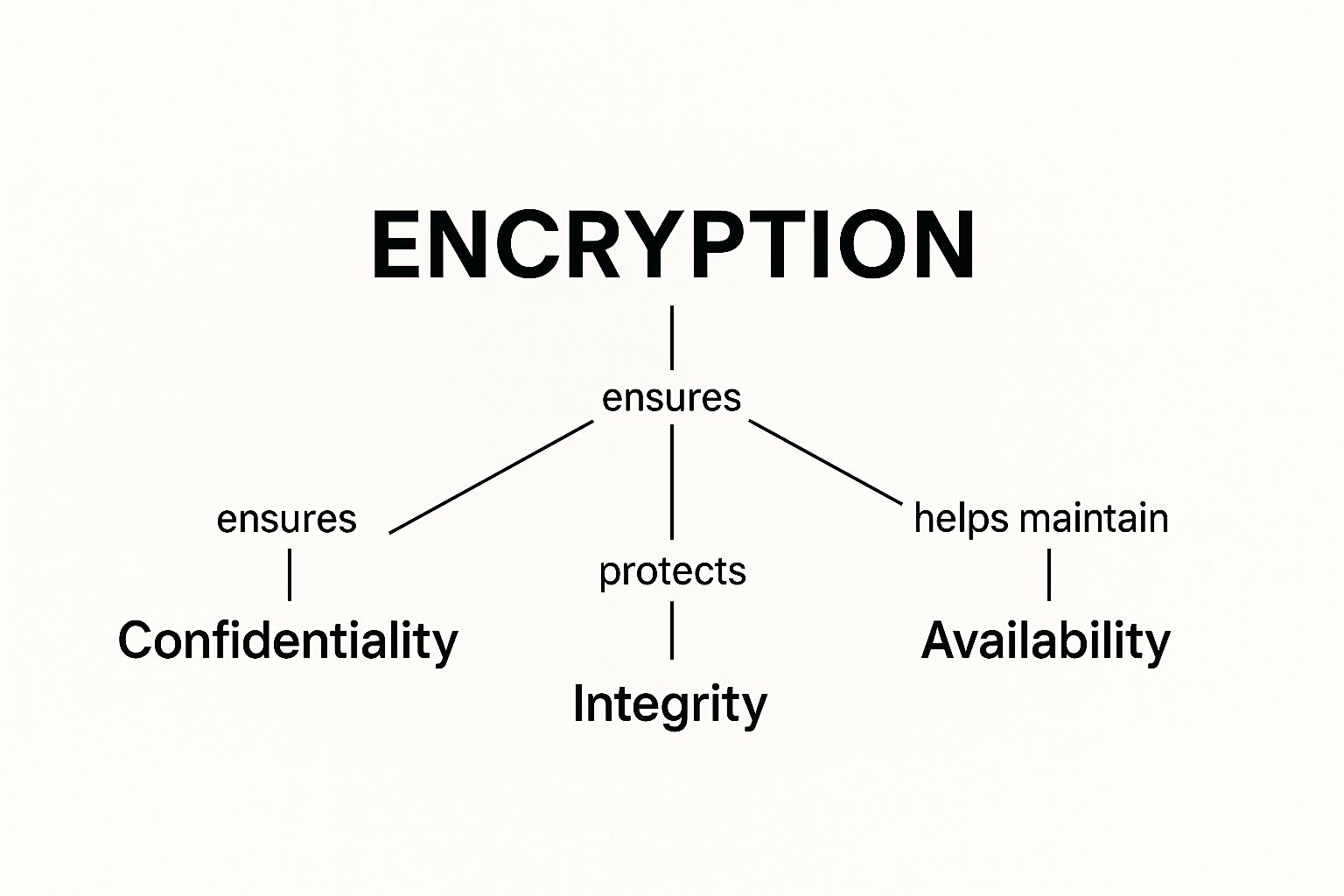
As the infographic shows, encryption directly ensures your documents remain private and their integrity is maintained, contributing to their overall availability for authorized users. To help you understand how these protocols work in the real world, let’s compare the most common ones.
Security Protocol Comparison: What Actually Matters
A practical comparison of major security protocols showing real-world performance, implementation difficulty, and when to use each one.
| Protocol Type | Protection Level | Best Use Cases | Speed Impact | Setup Complexity |
|---|---|---|---|---|
| AES-256 | Very High | Protecting files stored on servers (data “at rest”) or encrypting local hard drives. | Minimal impact on modern hardware; optimized for performance. | Low for users; handled by the service provider. |
| SSL/TLS | High | Securing data as it travels over the internet (e.g., website browsing, file uploads/downloads). | Minor latency during the initial connection handshake, then negligible. | Low for users; indicated by “https://” and the padlock icon. |
| E2EE | Maximum | Securing private messages, sensitive documents, and any communication where the service provider should have zero access. | Slightly more processing overhead than SSL/TLS, but usually unnoticeable. | Low for users; integrated into apps like Signal or WhatsApp. |
The key takeaway from this comparison is that these protocols are not interchangeable; they work together. A truly secure platform uses SSL/TLS to protect your files during transfer and AES-256 to protect them once they are stored. E2EE adds another layer on top of that for maximum privacy.
The Digital Vault: AES-256 Encryption
When a platform mentions AES-256 encryption, it is referring to the strength of the security protecting your digital data. In simple terms, AES-256 acts like an advanced lock on a highly secure digital vault. Furthermore, it is widely recognized as the gold standard for protecting data “at rest,” which means files stored on servers, cloud platforms, or backup systems.
For example, imagine a vault secured by a key so complex that it has more possible combinations than there are atoms in the known universe. As a result, AES-256 provides an extraordinary level of protection against unauthorized access. Consequently, even the world’s most powerful supercomputers would require billions of years to break the encryption using brute-force methods.
This is why governments, financial institutions, healthcare providers, and security-focused organizations rely on AES-256 to protect highly sensitive information. Moreover, its proven reliability makes it one of the most trusted encryption standards available today.
Therefore, when you upload a document to a secure file-sharing or cloud storage platform, AES-256 helps ensure your information remains protected. Even if a cybercriminal managed to gain physical access to a server, the encrypted files would remain unreadable without the correct decryption key. Ultimately, AES-256 encryption provides the strong security foundation businesses and individuals need to protect valuable data from modern cyber threats.
The Armored Truck: SSL/TLS Protection
While AES-256 protects your files when they are sitting still, SSL/TLS (Secure Sockets Layer/Transport Layer Security) protects them while they are in motion. Think of it as the armored truck that transports your assets between banks. SSL/TLS creates a secure, encrypted tunnel between your device and the server you’re connecting to.
You see this in action every day when you visit a website with “https://” in the URL and a padlock icon in your browser. This protocol prevents “man-in-the-middle” attacks, where an attacker tries to eavesdrop on your connection to steal data as it travels across the internet. When you need to transfer large files securely, SSL/TLS is non-negotiable.
The Ultimate Secret Handshake: End-to-End Encryption (E2EE)
End-to-end encryption (E2EE) provides one of the highest levels of security and privacy available for secure document sharing. With E2EE, only the sender and the intended recipient possess the keys required to decrypt and access the information. As a result, no unauthorized party can view the content during storage or transmission.
Furthermore, not even the service provider can access the encrypted files or messages. Therefore, businesses and individuals can share sensitive information with greater confidence, knowing that their data remains private throughout the entire process.
To better understand this concept, imagine placing a letter inside a secure box, locking it, and sending it to a trusted friend who holds the only other key. In this scenario, the postal service acts as the delivery provider. Although it transports the box from one location to another, it cannot unlock or view the contents inside.
Similarly, end-to-end encryption ensures that files, messages, and documents remain inaccessible to anyone except the intended recipient. Consequently, even if a cybercriminal intercepts the data during transit, the information remains unreadable without the correct decryption key.
Moreover, E2EE helps organizations strengthen data privacy, meet compliance requirements, and reduce the risk of unauthorized access. Ultimately, it creates a secure communication environment where sensitive information remains protected and accessible only to trusted parties.
Taking Control: Who Gets Access and When

Strong encryption creates the digital vault, but it doesn’t decide who gets the keys. True secure document sharing isn’t just about locking files—it’s about managing precisely who can open them, what they’re allowed to do, and for how long. Think of it like a modern office building’s security. A strong front door is just the beginning. The system also uses keycards to control access to specific floors, logs when people enter and exit, and automatically revokes a contractor’s access when their job is done.
This precise level of control is essential for protecting your most sensitive information. Relying on encryption alone is a bit like leaving the vault door open once you’re inside; a single compromised password could expose everything. That’s why the best platforms now offer sophisticated permission systems that give you complete command over every file you share. This capability is no longer a luxury but a core expectation in a growing market. In fact, the secure file sharing sector is projected to be worth around $15 billion by 2025, driven by the need for smarter, more controllable cloud solutions. You can dive deeper into the future of the secure sharing market to see where the industry is headed.
Building a Layered Defense with Access Controls
A truly resilient security strategy combines several features to create layers of defense. This approach ensures that even if one control fails, others are still in place to protect your data. Key controls include:
- Time-Based Access: This feature automatically makes a link invalid after a set time. It’s the digital version of a hotel keycard that stops working after you check out, making sure temporary collaborators or clients don’t have permanent access.
- Download Restrictions: Sometimes you want someone to view a document but not keep a copy. Disabling downloads is a simple way to prevent files from being saved onto local devices, where they could be easily duplicated and shared without your consent.
- Dynamic Watermarking: By overlaying the viewer’s email or IP address directly onto the document, this feature is a powerful deterrent against screenshots and unauthorized sharing. If a watermarked document ever leaks, you know exactly who the source was.
- Multi-Factor Authentication (MFA): Requiring a second form of proof—like a code sent to a phone—adds a critical security layer. Even if a password is stolen, MFA makes it significantly harder for an unauthorized person to gain access.
Tracking Every Interaction with Audit Trails
Beyond setting permissions, you need visibility. A detailed audit trail, or activity log, gives you a complete history of every interaction with a shared document. It tells you who viewed, downloaded, or even attempted to access a file, along with a timestamp for each action.
This log is priceless for compliance audits and for investigating potential security issues. If you ever suspect a data leak, the audit trail is the first place you’ll look for definitive answers. Our guide offers more tips on putting these controls into practice for comprehensive secure file sharing. By combining these tools, you can move from a passive defense to an active security posture, maintaining full authority over your data no matter where it goes.
Making Security Feel Effortless for Your Team
The most powerful security system in the world is useless if people find it too difficult or frustrating to use. Unfortunately, when security feels like an obstacle, employees often look for alternative methods that appear faster or more convenient. As a result, they may send files through personal email accounts or consumer-grade applications that expose sensitive business information to unnecessary risks.
Therefore, successful secure document sharing depends on more than just strong technology. It also requires user-friendly workflows that make the secure option the easiest and most practical choice. In other words, effective security should work seamlessly in the background without disrupting productivity. Ultimately, the best protection feels almost invisible to the user while still maintaining strong safeguards.
Fortunately, smart platform design helps solve this challenge. Instead of requiring users to navigate complex security settings for every file, leading solutions use progressive security controls. Furthermore, these systems automatically apply appropriate security policies based on a document’s content, classification, sensitivity level, or user behavior.
For example, an employee sharing a public marketing brochure does not require the same security restrictions as someone sending confidential financial forecasts or client records. Consequently, modern secure document-sharing platforms can intelligently adjust protection levels based on the situation. Moreover, this automated approach improves both security and user experience. As a result, businesses can reduce risk while maintaining efficiency and productivity across their organization.
Designing for Adoption
The goal is to create an experience so smooth that employees actually prefer using the secure platform. This is done by focusing on user-friendly design principles that reduce mental effort and make security a natural part of the job. Key elements include:
- Intelligent File Classification: Systems that automatically scan and tag documents based on keywords like “confidential,” “invoice,” or “contract” can apply the right security policies without any user input.
- Automated Security Checks: Behind-the-scenes processes can verify user identities, check device health, and watch for suspicious activity without interrupting what the user is doing.
- Context-Aware Permissions: The system can suggest the right sharing settings based on the recipient’s email domain or the user’s role, gently guiding them toward safer choices.
Here is an example of an interface designed for simple yet powerful document sharing controls.
This clean layout presents clear options for access control, link expiration, and download permissions without overwhelming the user. The power is in making advanced security settings accessible and easy to understand at a glance, turning security from a chore into a simple, straightforward action. By building these controls directly into the sharing process, the platform encourages safer habits by default. When security is this effortless, it stops being a hurdle and becomes a real advantage, ensuring teams can work together effectively without compromising on protection.
Next-Generation Security That’s Actually Here Now
While many are still setting up basic security, a new set of advanced tools is already changing what it means to keep data safe. This isn’t science fiction; these are practical technologies being used today to defend against increasingly clever threats. This new frontier of secure document sharing shifts from static walls to intelligent, adaptive systems that actively guard your information. This evolution is fueling huge market growth, with the managed file transfer (MFT) market valued at $2.1 billion in 2024 and growing fast. You can explore a detailed market forecast in this MFT industry analysis.
The Rise of Intelligent Defense Systems
At the front of this movement are a few key technologies that are rewriting the rules of data protection. These tools work together to build a security foundation that is both tougher and more transparent.
- Artificial Intelligence (AI) for Threat Detection: Think of AI as a security guard who never sleeps and gets smarter with every interaction. AI-powered systems analyze patterns in user behavior, file access, and network traffic. They can tell the difference between normal day-to-day activity and the small clues that signal a potential breach, like a file being accessed at an odd hour or from an unfamiliar location. This allows them to flag or stop threats before damage occurs, moving from a reactive to a proactive defense.
- Blockchain for Tamper-Proof Audits: Often tied to cryptocurrency, blockchain technology offers incredible value for creating unchangeable records. For document sharing, this means building a tamper-proof log of every single action. Each time a file is viewed, edited, or shared, the event is recorded as a permanent block in a chain. This creates an unmatched level of transparency and accountability, making it impossible for anyone to secretly change records or deny their actions. It’s the ultimate source of truth for your sensitive data’s history.
- Zero-Trust Security Models: The old way of thinking about security was like a castle with a moat—once you were inside, you were trusted. The zero-trust model flips this idea on its head, assuming that threats can come from anywhere, even inside your network. It works on a simple principle: “never trust, always verify.” Every single request to access a document, no matter who it is or where they are, must be authenticated. While this might sound slow, modern systems use smooth, multi-factor checks that don’t get in the way of legitimate users, resulting in a much stronger defense. You can find out more about putting these principles into practice with our guide on secure online file transfer.
These next-generation features aren’t just for giant corporations. Forward-thinking companies in finance, healthcare, and government are already using them to protect their most critical information. By adopting these tools, organizations are building a security framework that is intelligent, transparent, and strong enough to meet the challenges of tomorrow.
How Different Industries Handle Secure Document Sharing
The core idea of secure document sharing is the same everywhere, but how it’s put into practice changes dramatically from one industry to another. Security isn’t a one-size-fits-all t-shirt; the rules that govern a law firm are worlds apart from those of a healthcare provider. Each sector has its own set of regulations and operational challenges, which dictates how they protect sensitive information while still getting work done.
Healthcare: Protecting Patient Data While Saving Lives
In the healthcare industry, the Health Insurance Portability and Accountability Act (HIPAA) sets strict standards for protecting Protected Health Information (PHI). Consequently, healthcare providers must implement strong security measures when storing, accessing, and sharing patient data. The stakes are extremely high because a data breach can result in significant financial penalties and, more importantly, place patients at risk.
For example, imagine a hospital needs to send a patient’s MRI scans to a specialist in another country for an urgent second opinion. In this situation, the files are large, contain sensitive medical information, and must be transferred quickly and securely. However, regular email is not a suitable option because it often lacks the encryption, access controls, and tracking capabilities required for compliance.
Therefore, healthcare organizations rely on HIPAA-compliant file-sharing platforms to protect sensitive information. These platforms use end-to-end encryption to ensure that only authorized recipients can access the files. Furthermore, they provide detailed audit trails that record every access attempt, download, and file activity.
In addition, administrators can apply advanced security settings such as password protection, access restrictions, and automatic link expiration. For instance, a sharing link can be configured to expire after 24 hours, reducing the risk of unauthorized access. As a result, healthcare providers can meet strict compliance requirements while enabling fast, secure, and potentially life-saving collaboration between medical professionals. Ultimately, secure file-sharing solutions help protect patient privacy while improving healthcare efficiency.
Legal: Upholding Attorney-Client Privilege
For law firms, attorney-client privilege is one of the most important responsibilities they must protect. Consequently, legal documents such as contracts, evidence files, case records, and discovery materials require the highest level of security. Any unauthorized disclosure could jeopardize a case, damage a firm’s reputation, and potentially result in serious legal consequences.
Furthermore, legal professionals regularly exchange highly sensitive information with clients, courts, and other parties. Therefore, secure document-sharing solutions play a critical role in maintaining confidentiality and compliance throughout the legal process.
For example, consider a legal team managing a complex corporate merger. They need to share draft agreements and confidential documents with their client for review. However, they must ensure that the information cannot be copied, printed, downloaded, or forwarded to unauthorized individuals.
To address this challenge, the firm uses a secure document-sharing portal with advanced access controls. In addition, the documents are shared using view-only permissions and strict download restrictions. As a result, recipients can review the content without creating unauthorized copies.
Moreover, the platform applies a dynamic watermark displaying the client’s name and email address across the document while it is being viewed. Consequently, users are discouraged from taking screenshots or sharing the information with others. At the same time, detailed audit logs record all viewing activity, providing greater transparency and accountability.
Ultimately, this layered security approach allows law firms to protect confidential information, maintain attorney-client privilege, and facilitate secure collaboration with clients. As a result, legal teams can confidently share sensitive documents while reducing security and compliance risks.
Finance: Balancing Speed and Regulatory Compliance
Financial institutions operate in a highly regulated environment where security, compliance, and speed are equally important. Consequently, organizations must protect sensitive financial records and client information while responding quickly to market opportunities. Furthermore, regulatory authorities such as the SEC and FINRA enforce strict requirements designed to safeguard financial data and maintain market integrity.
The risks are substantial. In fact, a 2023 study found that 82% of financial services organizations had experienced a data breach. As a result, financial institutions continue to invest heavily in secure document-sharing and data-protection technologies. Therefore, implementing robust security measures is no longer optional but an essential business requirement.
For example, imagine an investment bank needs to distribute a confidential quarterly earnings report to its board of directors before the information becomes public. Because this data is highly market-sensitive, any unauthorized disclosure could result in insider trading concerns, regulatory investigations, and significant financial penalties.
To address these risks, the bank uses a secure document-sharing platform with multi-factor authentication (MFA). In addition, each board member receives a unique, password-protected access link. However, the security process does not end there. To view the report, directors must also enter a verification code sent directly to their mobile device.
As a result, the institution can verify the identity of every authorized recipient before granting access. Moreover, the platform creates a secure and auditable distribution channel that records access activity and strengthens accountability. Ultimately, this layered approach helps financial organizations protect sensitive information while meeting both security and regulatory obligations.
To better understand these industry-specific needs, the table below breaks down the key compliance standards, challenges, and solutions for each sector.
| Industry Sector | Key Compliance Standards | Primary Security Challenges | Proven Solution Types | Success Metrics |
|---|---|---|---|---|
| Healthcare | HIPAA, HITECH | Protecting PHI, managing large medical files, ensuring fast access for emergencies. | HIPAA-compliant file sharing platforms, end-to-end encryption, detailed audit trails. | Zero PHI breaches, full compliance audit pass rates, time-to-consultation reduction. |
| Legal | Attorney-Client Privilege, GDPR | Preventing unauthorized disclosure of case files, controlling document printing/copying. | Secure client portals, dynamic watermarking, view-only permissions, access controls. | Maintained case confidentiality, no accidental data leaks, positive client trust surveys. |
| Finance | SEC, FINRA, SOX | Securing market-sensitive data, preventing insider trading, high-frequency transactions. | Secure data rooms with MFA, granular user permissions, immutable audit logs. | 100% compliance with regulatory reporting, successful security audits, no data-related trading halts. |
As you can see, while the goal is always to protect information, the specific tools and strategies—from watermarking in legal to MFA in finance—are tailored to meet the distinct risks and rules of each field. This adaptability is the key to effective security.
Your Roadmap to Bulletproof Document Security
Implementing a secure document-sharing system involves much more than simply purchasing new software. Instead, it requires a fundamental shift in your organization’s security practices and daily workflows. Therefore, businesses should approach implementation as a long-term strategy rather than a one-time technology upgrade.
To achieve strong and reliable protection, organizations need a clear plan that addresses technology, internal policies, and employee behavior. Furthermore, a successful rollout focuses not only on installing software but also on encouraging lasting security habits throughout the company. As a result, businesses can reduce risks while maintaining productivity and operational efficiency.
The first step is conducting an honest security assessment to identify vulnerabilities before cybercriminals can exploit them. For example, organizations should determine where sensitive data is stored, who has access to it, and how it is being shared. By answering these questions, businesses can quickly identify security gaps and prioritize the most critical improvements.
Once potential weaknesses have been identified, the next step is developing practical policies that protect the organization without creating unnecessary obstacles. However, this requires careful planning and balance. If security measures become too restrictive, employees may look for unofficial workarounds that introduce new risks.
Consequently, businesses should focus on creating security processes that are both effective and user-friendly. In addition, policies should align with the way employees actually work rather than forcing unrealistic procedures. Ultimately, the goal is to build a secure document-sharing environment that protects sensitive information while supporting productivity, collaboration, and business growth.
Creating a Lasting Security Culture
Technology and security policies are important, but they represent only part of an effective cybersecurity strategy. However, human behavior remains one of the most common causes of security incidents and data breaches. Therefore, any successful security roadmap must include ongoing user education and awareness programs that actively engage employees.
Instead of relying on a once-a-year training session, organizations should make cybersecurity a regular part of workplace culture. Furthermore, interactive learning methods often produce better results because employees remain more engaged and retain information more effectively.
Gamification
For example, businesses can turn security awareness training into a friendly competition. Employees may earn points, badges, or leaderboard rankings for completing security modules, reporting suspicious activity, or successfully identifying simulated phishing attempts. As a result, participation increases while security knowledge improves across the organization.
Incentive Programs
In addition, organizations can reward individuals or teams that consistently follow cybersecurity best practices. Whether through recognition programs, bonuses, or other incentives, positive reinforcement encourages employees to maintain secure habits. Consequently, security becomes a shared responsibility rather than an administrative requirement.
Real-World Simulations
Moreover, regular phishing simulations help employees develop practical skills in a safe environment. By exposing staff to realistic attack scenarios, organizations can improve awareness and strengthen threat detection capabilities. At the same time, these exercises provide valuable insights into areas where additional training may be required.
This proactive approach helps employees build confidence and develop the habits needed to recognize threats before they cause harm. Ultimately, a well-trained workforce becomes one of the strongest defenses against cyberattacks.
Furthermore, modern security platforms support these efforts by integrating security management, compliance monitoring, and threat detection into a centralized environment. As a result, administrators gain greater visibility into potential risks while simplifying policy enforcement across the organization.
Therefore, combining advanced technology, clear security policies, and continuous employee education creates a stronger and more resilient security culture. In the long run, this balanced approach helps organizations reduce risks, improve compliance, and better protect sensitive information.
Measuring Success and Adapting to Threats
You cannot improve what you do not measure. Therefore, organizations should establish clear metrics to evaluate the effectiveness of their security programs. Furthermore, success should not be measured solely by the number of threats blocked. Instead, businesses should also track user adoption of secure tools, reductions in risky behaviors, and improvements in the speed of identifying potential security concerns.
For example, monitoring how employees use secure file-sharing platforms can reveal whether security policies are being followed consistently. In addition, tracking incidents involving unauthorized file sharing can help identify areas that require further training or process improvements. As a result, organizations gain valuable insights into both security performance and user behavior.
Moreover, a data-driven approach enables businesses to continuously refine their security strategies and address vulnerabilities before they become serious problems. Consequently, organizations can respond more effectively to emerging threats while maintaining operational efficiency. At the same time, regular performance reviews ensure that security controls continue to align with business objectives and compliance requirements.
As your company grows, security measures must evolve as well. Therefore, organizations should view cybersecurity as an ongoing process rather than a one-time project. Ultimately, businesses that embrace continuous improvement create a stronger security culture that adapts to new challenges instead of simply reacting to them.
Ready to build your own roadmap to stronger document security? Digital Fusion Hub provides advanced security controls, secure file-sharing solutions, and user-friendly tools designed to protect your most valuable information. Furthermore, our platform helps businesses strengthen compliance, improve collaboration, and reduce security risks with confidence.